Watchlist Management

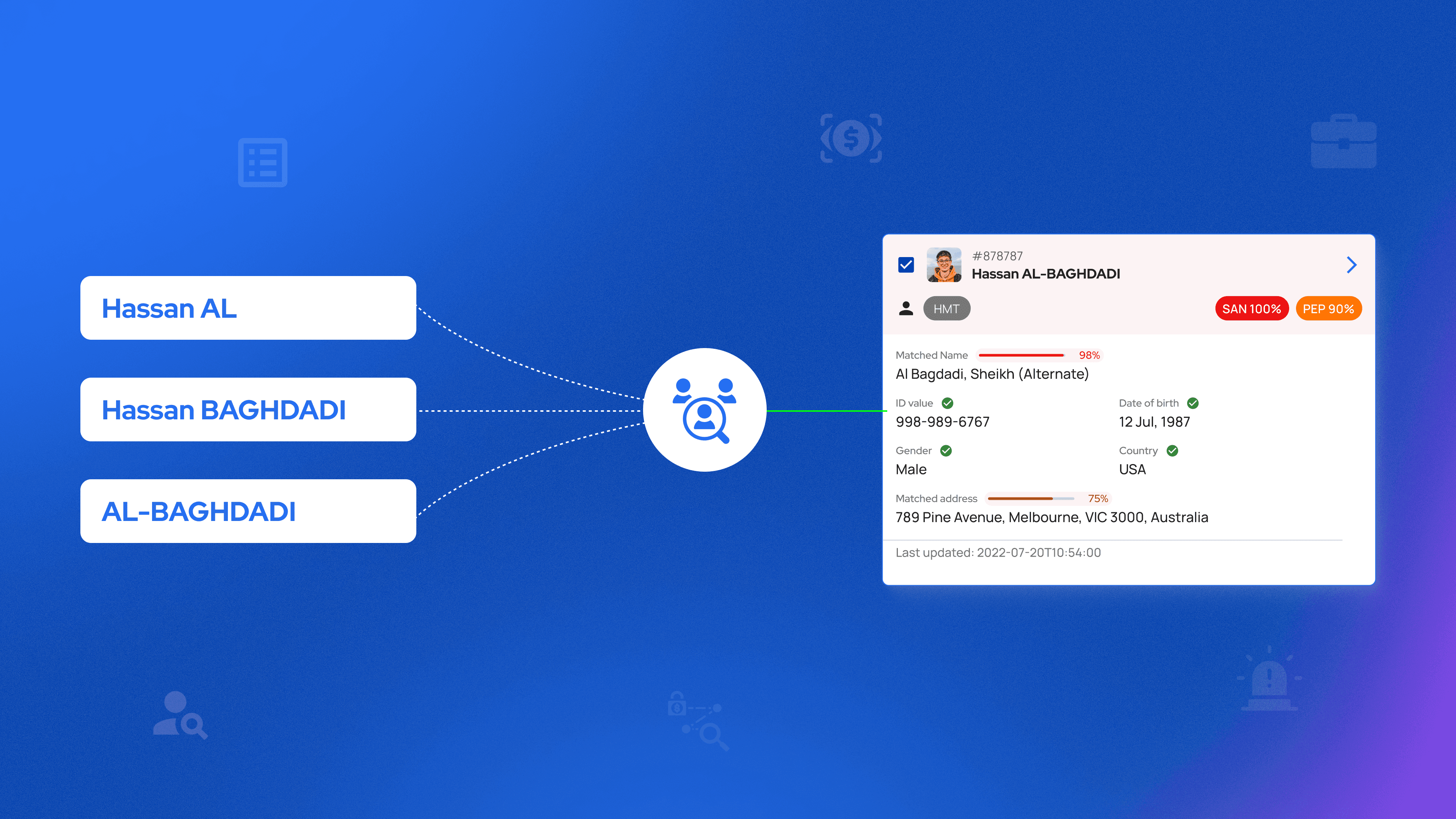
Compliance teams face a recurring challenge: names and data rarely appear in consistent, clean formats. Variations in spelling, transliteration, and incomplete information make it difficult to identify high-risk individuals or entities.
Fuzzy matching has become a critical technique in anti-money laundering (AML) and sanctions compliance because it improves screening accuracy, reduces false positives, and uncovers hidden links that exact matching would miss.
What Is Fuzzy Matching?
Fuzzy matching is a technique that identifies similarities between data entries even when they are not identical. Unlike exact matching, which requires an exact character-by-character match, fuzzy matching uses algorithms to measure how closely two pieces of data resemble one another.
This is especially important in compliance, where names can be spelled differently across jurisdictions, or where incomplete data may cause standard systems to fail.
Why Fuzzy Matching Matters in Compliance
Financial institutions must comply with FATF Recommendations requiring them to screen customers against sanctions, politically exposed persons (PEPs), and other high-risk lists.
If screening systems rely only on exact matches, they risk missing important connections, for example, between “Mohammed” and “Muhammad.” Fuzzy matching helps prevent these blind spots.
Common Challenges It Solves
Name variations: Different spellings of the same name.
Transliteration issues: Names converted between alphabets (e.g., Cyrillic to Latin).
Data errors: Typographical mistakes or incomplete records.
Alias detection: Identifying known aliases used to evade detection.
How Fuzzy Matching Works in Screening
Fuzzy matching relies on algorithms that score the similarity between two data points. If the score is above a threshold, the system flags it as a potential match.
Key Methods Used
Edit Distance (Levenshtein): Measures how many edits are needed to turn one word into another.
Phonetic Matching: Matches names that sound similar despite different spellings.
Token-Based Matching: Breaks down multi-part names and compares components.
When combined with advanced tools like FacctList, Watchlist Management, fuzzy matching can dramatically reduce false positives while still detecting high-risk entities.
Fuzzy Matching and Graph-Based Resolution
Fuzzy matching is powerful on its own, but it becomes even more effective when combined with relational data analysis.
Research shows that graph‑based entity resolution methods, when paired with attribute similarity (like fuzzy matching), significantly improve detection of hidden links among individuals.
For compliance teams, this means uncovering indirect ties between PEPs, SIPs, and RCAs that may not be visible in isolated records.
Regulatory Expectations
While regulators don’t prescribe specific algorithms, they expect firms to maintain effective screening systems. The FCA has criticised firms for failing to identify or act on adverse media signals, as well as broader weaknesses in AML screening and monitoring processes, which can lead to missed financial crime risks
This underscores the importance of adopting techniques like fuzzy matching to meet compliance obligations.
Benefits of Fuzzy Matching in AML Screening
Fuzzy matching offers significant advantages in the context of Anti-Money Laundering (AML) compliance. Traditional screening methods often struggle with variations in names, spellings, or transliterations, which can result in both missed matches and unnecessary false positives.
By applying advanced algorithms, fuzzy matching improves the precision and efficiency of screening processes. This not only enhances compliance accuracy but also helps financial institutions reduce operational strain, strengthen regulatory reporting, and protect against reputational damage
Reduced False Positives
By recognising small variations, fuzzy matching reduces unnecessary alerts, freeing compliance teams to focus on genuine risks.
Improved Detection of Hidden Risks
Alias and transliteration detection ensure high-risk entities cannot avoid screening by using alternate spellings.
Stronger Audit and Documentation
Fuzzy matching provides a clear audit trail of how potential matches were flagged, supporting regulatory inspections.
Final Thoughts
Fuzzy matching is now a cornerstone of effective compliance. By reducing false positives and capturing hidden risks, it strengthens AML screening and helps firms meet regulatory expectations.
Take the Next Step in Strengthening Compliance
Managing sanctions and high-risk list screening requires advanced tools that can handle complexity at scale.
With FacctView, Customer Screening, your organisation can leverage fuzzy matching to reduce false positives, improve accuracy, and stay ahead of regulatory obligations.
Contact Facctum today to see how FacctList can enhance your screening framework.